
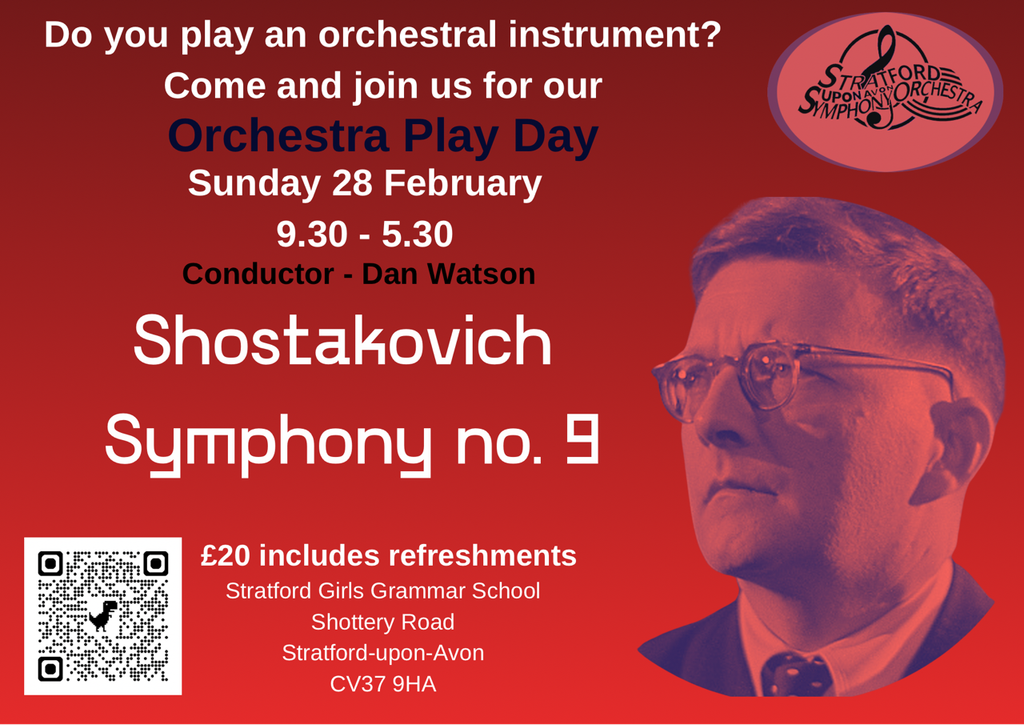
Shostakovich’s Symphony No. 9 in E-flat major, Op. 70
Instrumentation 3(1.2.picc).2.2.2 — 4.2.3.1 — tmp+2 — str
Looking for an exhilarating orchestral workout? Join us for a deep dive into Shostakovich’s dazzling Ninth Symphony—a 25-minute masterclass in wit, energy, and ensemble precision.
In 1945, Soviet authorities expected Shostakovich to mark the end of World War II with a massive, heroic Ninth Symphony to rival Beethoven. Instead, he shocked everyone with a brisk, neoclassical gem packed with circus-like fanfares, Haydnesque charm, and razor-sharp satire.
What to Expect as a Player:
- Strings: Expect brisk, classical-style agility rather than heavy romantic scrubbing. The outer movements demand crisp spiccato, clean off-the-string articulation, and tight rhythmic interplay, balanced by a lyrical, singing second movement.
- Woodwinds: This is a true showcase for the wind section. Almost every principal gets major solo exposure—including sparkling, acrobatic lines for piccolo and flute, rapid-fire clarinet runs, and one of the most famous, hauntingly expressive bassoon solos in the repertoire.
- Brass: Punchy, dry, and brilliant. The trumpets and horns drive the circus-like fanfares and sudden dynamic surprises, while the trombones and tuba anchor the satirical march rhythms—including a famously cheeky recurring trombone motif in the first movement.
- Percussion & Timpani: Tight, exposed, and rhythmic. The timpani drives the momentum throughout, joined by crisp snare drum, triangle, tambourine, cymbals, and bass drum that give the piece its unmistakable carnival edge.
Best suited for: Confident sight-readers (roughly Grade 6+ standard) who enjoy fast tempos, sudden character shifts, and transparent chamber-like textures where every line counts.